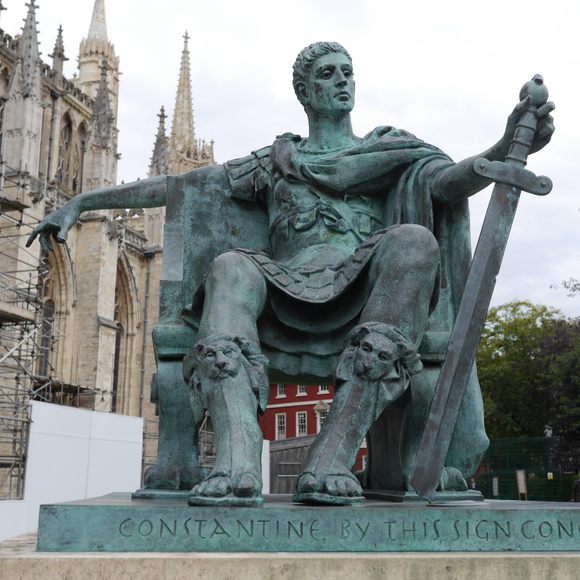
Emperor Constantine: The Architect of a New Era

Emperor Constantine, also known as Constantine the Great, is one of the most significant figures in Roman history. His reign marked a pivotal turning point in the Roman Empire, influencing not only the political landscape but also the religious and cultural fabric of Europe. Born in AD 272 in what is now Serbia, Constantine’s rise to power and his subsequent reforms laid the groundwork for the transition from a pagan empire to a Christian one, shaping the future of Western civilization.
Early Life and Rise to Power
Constantine was born to a family with military and political connections. His father, Constantius Chlorus, was a Roman army officer who later became Caesar under Emperor Diocletian. Following his father’s death in AD 306, Constantine was proclaimed emperor by his troops in Britain. His ascent was not without challenges; the Roman Empire was fragmented, with multiple claimants to the throne. Over the next several years, Constantine engaged in a series of civil wars against rival emperors, most notably Maxentius and Licinius.
The decisive moment in Constantine’s rise came in AD 312 at the Battle of the Milvian Bridge, where he faced Maxentius. According to historical accounts, Constantine experienced a vision before the battle, claiming to have seen a cross in the sky with the words “In this sign, conquer.” This vision led him to adopt the Christian symbol of the Chi-Rho as his battle standard. The victory at Milvian Bridge not only solidified his power but also marked the beginning of a new era for Christianity within the Roman Empire.
The Edict of Milan
One of Constantine’s most significant contributions to history was the Edict of Milan, issued in AD 313. This decree granted religious tolerance throughout the empire, allowing Christians to practice their faith openly without fear of persecution. The Edict of Milan was a monumental shift in policy, as Christians had faced severe oppression under previous emperors, particularly during the reign of Diocletian.
The edict not only legalized Christianity but also restored confiscated property to Christians, further solidifying the faith’s position within the empire. Constantine’s support for Christianity was not merely a personal conviction; it was a strategic move to unify the empire under a single religion, fostering loyalty and stability in a time of political fragmentation.
Founding of Constantinople
In AD 330, Constantine made a bold decision that would have lasting implications for the Roman Empire: he founded a new capital, Constantinople, on the site of Byzantium. This city was strategically located at the crossroads of Europe and Asia, making it a vital center for trade and military operations. Constantine envisioned Constantinople as a “New Rome,” a city that would embody the glory and power of the empire.
The establishment of Constantinople marked a significant shift in the center of power from Rome to the east. The city was designed with grand architecture, including the famous Hagia Sophia, and was fortified to withstand attacks. Over time, Constantinople became a cultural and economic hub, influencing the development of Eastern Orthodox Christianity and serving as a bastion of the Byzantine Empire for over a thousand years.
Religious Reforms and the Council of Nicaea
Constantine’s reign was characterized by his active involvement in religious affairs. In AD 325, he convened the First Council of Nicaea, which aimed to address the growing divisions within Christianity, particularly the Arian controversy. This theological dispute centered on the nature of Christ and his relationship to God the Father. The council produced the Nicene Creed, a statement of faith that affirmed the divinity of Christ and established a unified Christian doctrine.
Constantine’s role in the council was significant; he sought to promote unity within the Christian community and reduce sectarian conflict. His involvement in ecclesiastical matters, however, was not without controversy. While he championed Christianity, he also maintained elements of traditional Roman religion, often blending the two in his policies. This duality reflected the complexities of his reign and the challenges of governing a diverse empire.
Legacy and Impact
Emperor Constantine’s legacy is profound and multifaceted. His support for Christianity transformed the religion from a persecuted sect to the dominant faith of the Roman Empire. This shift had far-reaching consequences, influencing the development of Western civilization, art, and philosophy. The establishment of Constantinople as a major center of power and culture laid the groundwork for the Byzantine Empire, which preserved and transmitted classical knowledge through the Middle Ages.
Moreover, Constantine’s reign marked the beginning of the intertwining of church and state, a relationship that would shape European politics for centuries. His policies set a precedent for future emperors and monarchs, who would often seek the church’s endorsement to legitimize their rule.
In conclusion, Emperor Constantine was a transformative figure whose actions reshaped the Roman Empire and laid the foundation for the Christianization of Europe. His vision of a unified empire under a single faith, coupled with his strategic political maneuvers, ensured his place in history as one of the most influential leaders of antiquity. The legacy of Constantine continues to resonate today, reminding us of the enduring power of faith and the complexities of governance in a diverse society.
Share this post